Winter Wonders: Explore Delhi/NCR’s Hidden Treasures with Rentnhop Bike Rentals
Red Fort and India Gate have queues every weekend, but if you’re exploring the city with a Delhi motorcycle rental or looking for a bike on rent in Delhi, there are far quieter places worth your time. Feroz Shah Kotla, which is arguably more interesting than either of them, is often nearly empty. Built in 1354 by Sultan Feroz Shah Tughlaq as the centerpiece of his city Firozabad, the fort has one of the most quietly remarkable objects in all of Delhi sitting inside it. An Ashokan pillar carved in the 3rd century BC under Emperor Ashoka, transported intact from somewhere in present-day Haryana, and installed here by Feroz Shah more than 1,600 years after it was first made. It’s still standing. Ashoka’s inscriptions are still on it, still readable to anyone who knows Brahmi script. Standing in front of it and actually trying to hold that timeline in your head does something strange to you.
The fort also has a reputation as one of Delhi’s most haunted places. People have believed for centuries that djinn live in the ruins. This isn’t folklore. It happens every single week. If you’re there on a Thursday evening you’ll see it, and it’s one of those Delhi experiences that’s genuinely hard to shake afterwards, especially if you’ve reached here on a bike on rent in Delhi and stayed past sunset.
Winter fog in these ruins is something else. Mist settling between the old walls, the Ashokan pillar fading into grey above you, the city outside feeling very far away. Entry is ₹35 for Indian nationals. If you’re navigating the city through a Delhi motorcycle rental, foggy winter mornings are the pick. Or Thursday evenings if you want to catch the offerings.
Sunder Nursery — The One Right Next to Humayun’s Tomb That Nobody Goes Into
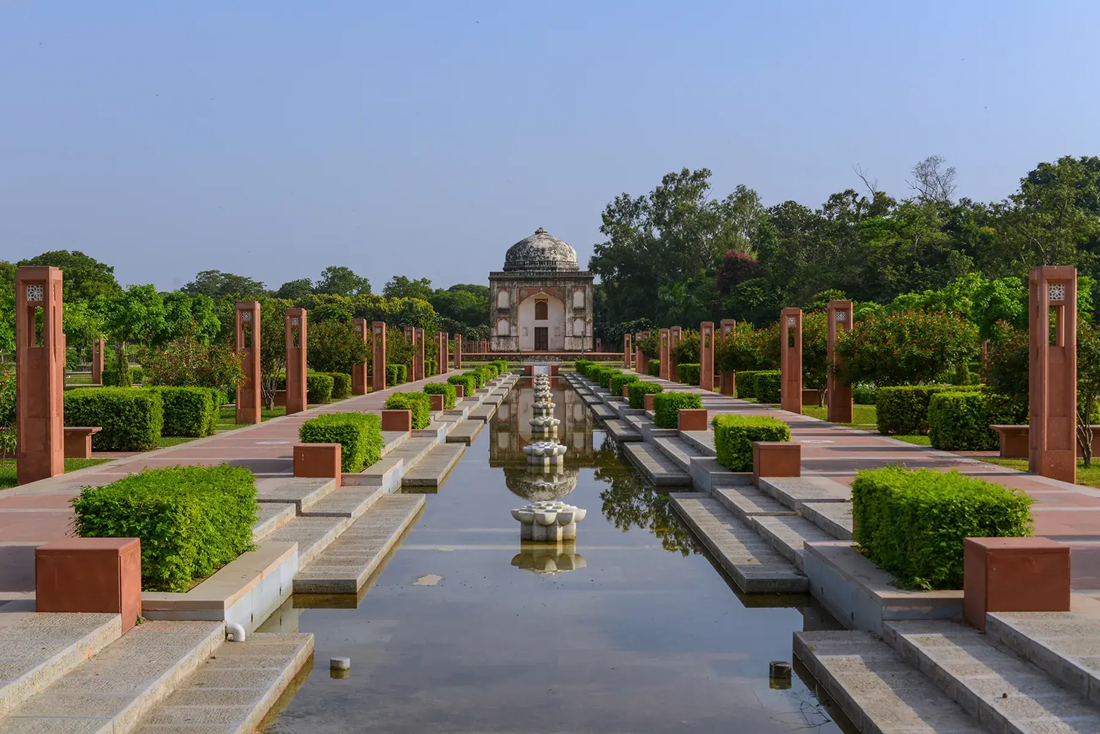
Most people visit Humayun’s Tomb, get their photos, and leave. Almost nobody notices what’s sitting right next to it.
Sunder Nursery is 90 acres, directly beside the tomb complex, just a short road separating them. Three centuries of completely different stories on either side. It’s a heritage park spent the last decade being restored by the Aga Khan Trust for Culture and what they’ve managed to do with it is kind of hard to believe until you’re standing in it. Medieval Mughal-era structures dotted throughout, some of them six hundred years old, just sitting there quietly between walking paths and restored water bodies and trees that were already old when most of the world’s current cities didn’t exist yet.
In winter it gets a bit magical. Over 90 heritage trees, hundreds of bird species, and on a foggy morning the whole place feels slightly dreamlike old structures materialising out of the mist as you walk toward them, birds going off somewhere above you in the canopy. There are peacocks. Not in enclosures. Just wandering around, being peacocks, completely unbothered by you.
It does weekend markets, bird walks, heritage walks, and a Christmas market in December that’s actually lovely if the timing works out. Entry is ₹35. Gates open at 7 AM. Go before Delhi wakes up properly. November through February is the window, early morning. The winter light coming through those trees is the kind of thing photographers plan trips around.
Sanjay Van — A Forest That Shouldn’t Exist Here
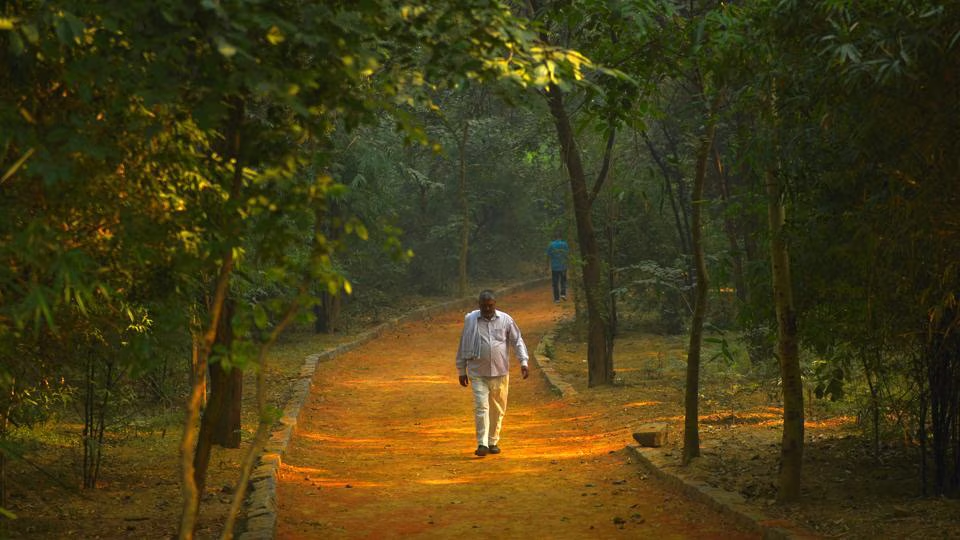
There’s a 780-acre forest in South Delhi. Most people who actually live here have no idea it exists.
Sanjay Van is near Vasant Kunj, completely surrounded by apartment blocks and urban sprawl on every side, and somehow it’s just stayed exactly what it is dense, a little wild, with crumbling medieval ruins scattered through it, proper hiking trails, and a kind of quiet that genuinely catches you off guard when you’ve just ridden in off Delhi’s roads.
In winter fog it gets properly eerie. Old structures from the Sultanate and Mughal periods just emerge out of the mist as you walk the kind of thing where you’re moving along a trail and suddenly there’s a ruin in front of you that you didn’t see coming. The birds here are something else entirely. Over 200 species recorded, and in winter you get migratory visitors coming in from Central Asia and Siberia that serious birders make dedicated trips for. The Dhobhi Ghat ruins and the ancient baoli tucked into the treeline are the sort of things you stumble onto mid-walk and just stop in front of for a bit, not entirely sure what you’re feeling.
Free entry. Open sunrise to sunset. Trails get uneven in stretches so wear actual shoes, not whatever you’d wear to a mall. And if there’s fog, go that morning. Don’t wait for a clearer day. The fog is the whole point. December and January mornings are the window. The thicker the fog, the better it gets that’s not an exaggeration.
Agrasen Ki Baoli — 108 Steps Into the Earth Behind Connaught Place
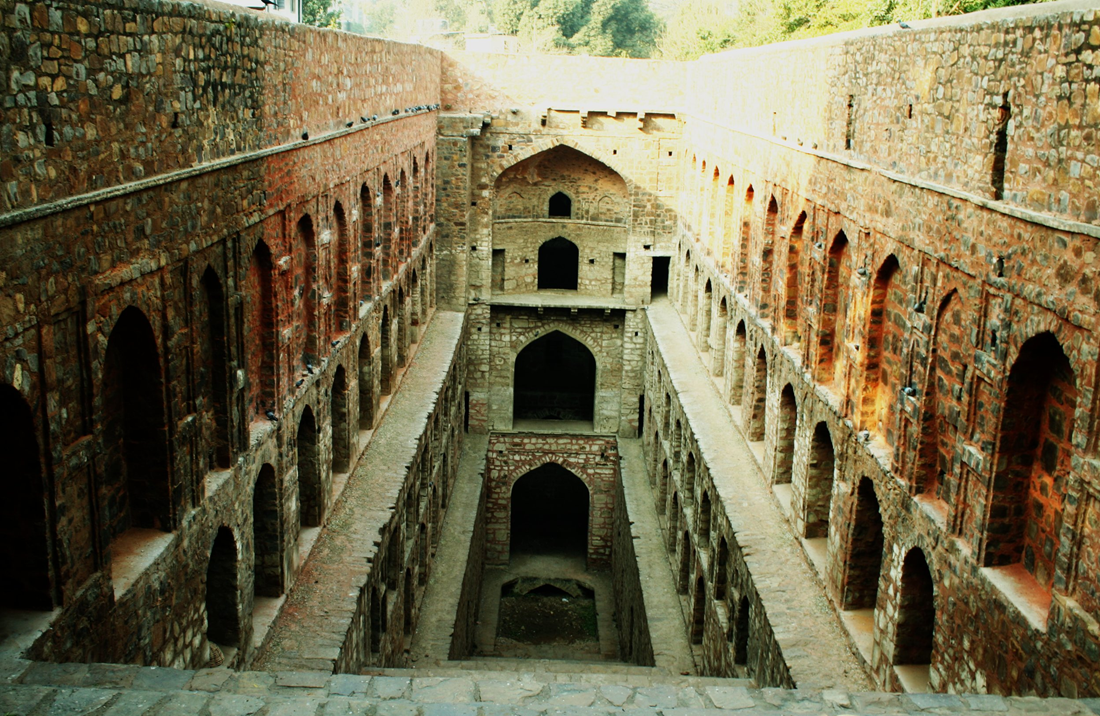
Most people walk straight past the gate without giving it a second look.
Agrasen Ki Baoli is a stepwell one of the most atmospheric historical structures in the whole city sitting on Hailey Road right in the middle of one of Delhi’s busiest commercial stretches. You ride through Connaught Place, all offices and coffee shops and noise, turn down a narrow road, step through a gate, and then you’re descending 108 perfectly symmetrical steps into an ancient structure that goes down toward the water table somewhere below street level.
The history is a bit murky. The stepwell gets connected by legend to the ancient king Agrasen, but historians reckon its current form is medieval probably Tughlaq or Lodi era. What nobody argues about is that it’s beautiful and genuinely strange in a way that’s hard to describe until you’re in it. The further down you go, the quieter everything gets. The air shifts. The road noise from above just disappears. And you’re left with old stone and this perfect symmetry dropping away into darkness below you.
In winter, the morning light that falls into the baoli is something else. Photographers make specific trips for it. On weekday mornings there’s often almost nobody else there, which for a free historical site in central Delhi is kind of unbelievable.
Weekday winter mornings are the move. Somewhere between 9 and 11 AM when the light falls directly down into the well. That’s the window.
Feroz Shah Kotla Fort — Delhi’s Most Haunted and Most Overlooked
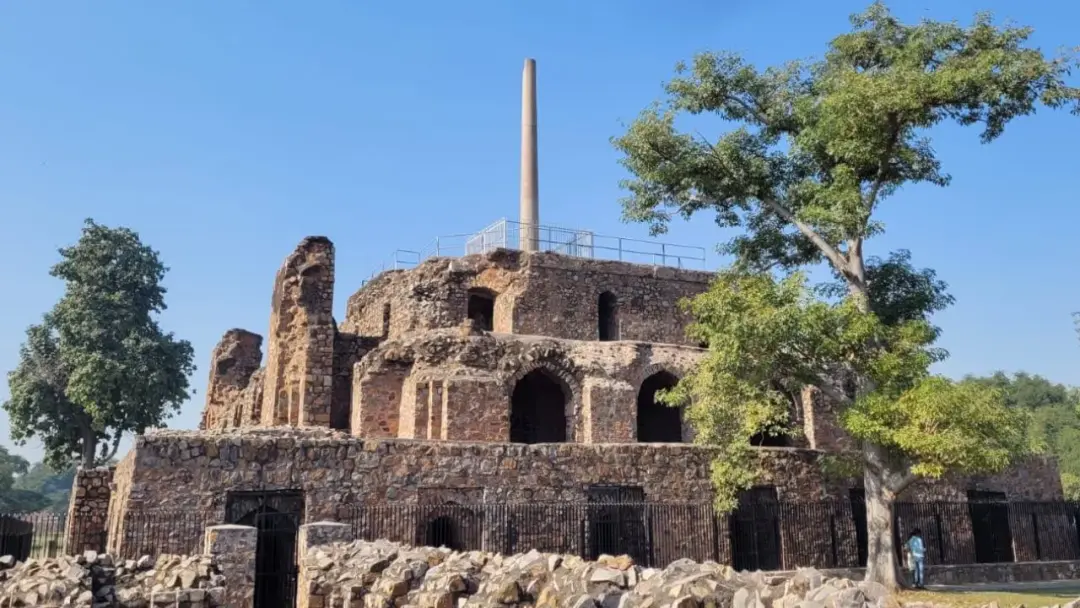
Red Fort and India Gate have queues every weekend, but if you’re exploring the city with a delhi motorcycle rental or looking for a bike on rent in delhi, there are far quieter places worth your time. Feroz Shah Kotla, which is arguably more interesting than either of them, is often nearly empty. Built in 1354 by Sultan Feroz Shah Tughlaq as the centrepiece of his city Firozabad, the fort has one of the most quietly remarkable objects in all of Delhi sitting inside it. An Ashokan pillar carved in the 3rd century BC under Emperor Ashoka, transported intact from somewhere in present-day Haryana, and installed here by Feroz Shah more than 1,600 years after it was first made. It’s still standing. Ashoka’s inscriptions are still on it, still readable to anyone who knows Brahmi script. Standing in front of it and actually trying to hold that timeline in your head does something strange to you.
The fort also has a reputation as one of Delhi’s most haunted places. People have believed for centuries that djinn live in the ruins. This isn’t folklore. It happens every single week. If you’re there on a Thursday evening you’ll see it, and it’s one of those Delhi experiences that’s genuinely hard to shake afterwards, especially if you’ve reached here on a bike on rent in delhi and stayed past sunset.
Winter fog in these ruins is something else. Mist settling between the old walls, the Ashokan pillar fading into grey above you, the city outside feeling very far away. Entry is ₹35 for Indian nationals. If you’re navigating the city through a delhi motorcycle rental, foggy winter mornings are the pick. Or Thursday evenings if you want to catch the offerings.
Tughlaqabad Fort — The Ruined City That Delhi Forgot
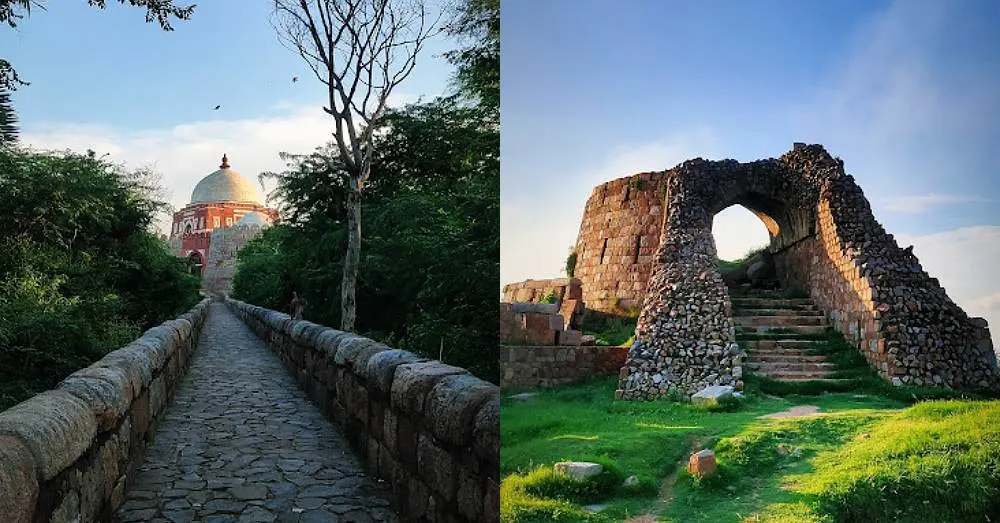
This one needs a bit more riding and a bit more effort. It’s worth both.
Tughlaqabad Fort is in South Delhi, about 15 kilometres from Qutub Minar, and it’s vast in a way that catches most people completely off guard. Built by Ghiyas-ud-Din Tughlaq in just four years between 1321 and 1325, it wasn’t just a fort it was an entire city. Palaces, mosques, markets, residential quarters, granaries, all of it wrapped inside massive rubble-built walls that run for over 6 kilometres. At its peak, it was one of the largest cities in the medieval world. Then it was abandoned. Within just a few years of being finished. And it’s been slowly going back to the earth ever since.
Walking through Tughlaqabad in winter fog, grass pushing up through what used to be market floors, old walls disappearing into grey on either side of you it’s one of those experiences that photographs just don’t catch. What gets you is the scale. The weight of something this enormous being built at tremendous human cost, lived in briefly, and then just.left. The Tughlaq dynasty moved on to the next city. Delhi moved on to the next dynasty. And Tughlaqabad sat here for seven hundred years getting quieter.
Most people visiting Delhi never come here. The ones who do tend to spend a couple of hours wandering around and leave feeling slightly different than when they arrived. Entry is ₹35 for Indian nationals.
Winter mornings are the call. The fog in those ruins is genuinely extraordinary.
Bhuli Bhatiyari Ka Mahal — The Hunting Lodge Nobody Can Find
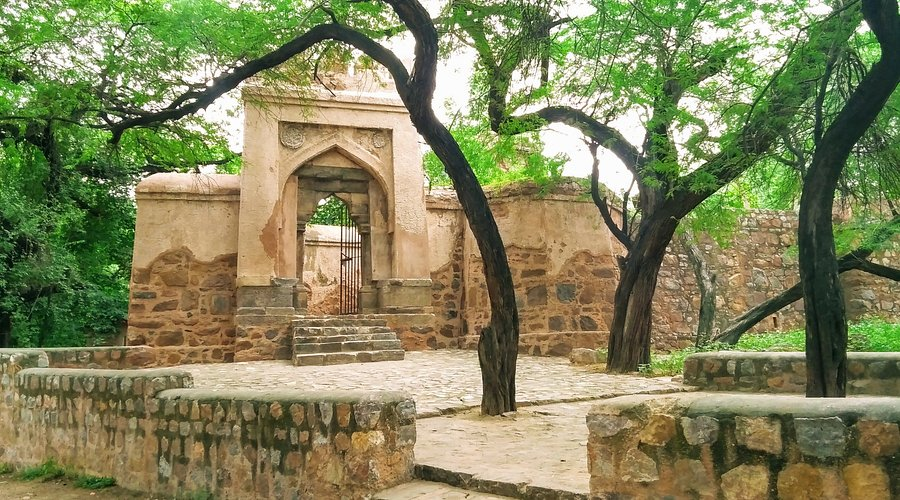
This one’s for people who want their history a little weird.
Bhuli Bhatiyari Ka Mahal is a 14th-century hunting lodge on the Delhi Ridge near Karol Bagh. Hidden behind trees, no signboard, and you’ll probably walk past the path twice before you find it. The name means something like the Palace of the Forgotten Lady, and the stories that come with the place a queen who disappeared, djinn, things people claim to hear at night are half the reason to go honestly.
It’s a single-storey ruin, properly old, surrounded by Ridge forest that gets foggy and dense in winter mornings and makes you forget you’re technically still inside Delhi. No entry fee. Hardly ever anyone around. The trails through the Ridge nearby are worth poking around in if you’ve got time.
Sunset is when it really does something to you. Light goes orange, shadows stretch out through the broken walls, and you can hear the city noise floating up through the trees from somewhere below but it feels far away in a way that’s hard to explain. The kind of evening you bring up in conversation weeks later.
Majnu Ka Tila — Little Tibet on the Banks of the Yamuna
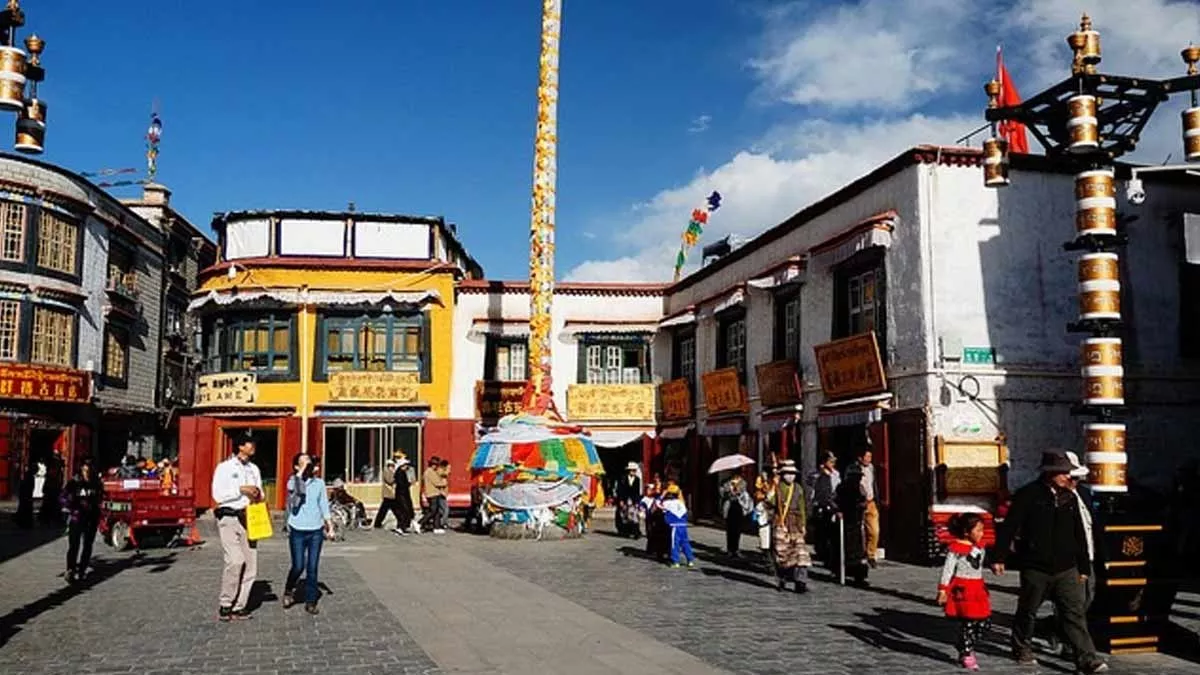
Not a ruin, not a monument. Just a neighbourhood that feels like it belongs somewhere else entirely.
Majnu Ka Tila is a Tibetan refugee colony on the Yamuna’s western bank. People started settling here after 1959 when the Dalai Lama fled to India. The name itself comes from a Sufi mystic called Majnu who apparently lived on this stretch of river centuries back, but walk in today and it’s entirely Tibetan feels nothing like the Delhi outside it.
Small restaurants doing thukpa, momos, butter tea. Shops with prayer flags, singing bowls, Tibetan jewellery, Buddhist texts. A monastery sitting at the centre where monks are already going about their morning while the lanes around them are still waking up. The pace is different. The smell is different. Even the light feels a bit different somehow.
Winter is when you want to come. The little cafes here wooden furniture, windows fogged up, warm in a way that hits properly after a cold ride along the Yamuna are exactly the right place to land on a cold morning. Get there before 10. Sit down. Order the thukpa, which is a Tibetan noodle soup and is precisely what your body wants after riding in the cold. Then just stay a while. There’s no rush in this place and that’s kind of the point.
Any winter morning works. Earlier the better.
Riding Delhi in Winter — A Few Things Worth Knowing
Fog is the big one. December through February it can just appear, sometimes dropping visibility down to a few metres on bad mornings. The rule is simple slow down, keep your headlight on even during the day, and don’t ride faster than you can actually see ahead of you. If that means crawling, you crawl. It’s not a reason to stay home, just a reason to stop being casual about it.
Layer up properly because a Delhi winter morning on a moving bike is a specific kind of cold. It gets into your bones in a way that standing around outside doesn’t prepare you for. Thermal base layer, wind-resistant jacket, gloves that’s the minimum. Cover your ears too. More people wish they had than wish they hadn’t.
If you’re after those proper monument shots, the light only shows up in small windows. That warm golden glow that makes Delhi’s ruins and parks look the way they do in good photographs it’s there between roughly 8 and 10 AM, and then again just before sunset. Build your day around those windows rather than hoping you stumble into them.
And just fill your tank before you head out. Navigating foggy unfamiliar lanes in South Delhi is already enough to deal with. A full tank is one less thing sitting in the back of your head.
The Point of All This
Delhi has a way of making people think they’ve figured it out. The monuments, the markets, the neighborhoods that show up in every travel piece. People do the rounds and leave feeling like they’ve got a handle on the place.
They don’t. Nobody really does. The city is too old and too many things at once for that. There are stepwells tucked behind office buildings, ruined cities sitting in the southern suburbs, forests in the middle of residential areas, a Tibetan colony on the riverbank that’s been there sixty years and never made it onto anyone’s list.
Winter is when you go looking for all of it. The cold keeps most people away. The fog does something strange to the sense of time everything feels slightly outside of normal when you’re moving through it. And on a bike you can just go at your own pace, stop when something catches your eye, double back when you miss a turn, stumble onto things that aren’t on any map.
Rent from RentnHop, get out before the fog burns off, and go find the Delhi that most people never see. It’s been there the whole time.



0 Comments